<img height="1" width="1" alt="" style="display:none" src="https://www.facebook.com/tr?id=808984019221058&amp;ev=PixelInitialized">

3 min read

Stop Blaming the Tools: Why Your CRM Is the Real AI Problem

Stop Blaming the Tools: Why Your CRM Is the Real AI Problem
6:07

Why do so many organizations invest in AI tools… yet still struggle with unreliable outputs, inconsistent insights, and low trust in the results?

The short answer:

Most AI problems are actually data problems.

Organizations keep layering AI tools onto disconnected systems, inconsistent processes, and unreliable CRM data and then wonder why the outputs feel inaccurate, generic, or difficult to trust.

According to LeadG2’s Revenue Enablement in the AI Era report, CRM users are nearly 50% more likely to be very confident in their data than organizations without one.

That’s not a software coincidence. It’s a revenue operations reality.

The Real AI Gap Is Foundation, Not Adoption

Right now, nearly every organization is experimenting with AI. The problem is that most companies are treating AI adoption as the strategy itself rather than evaluating whether the underlying systems are actually ready to support it.

The report found:

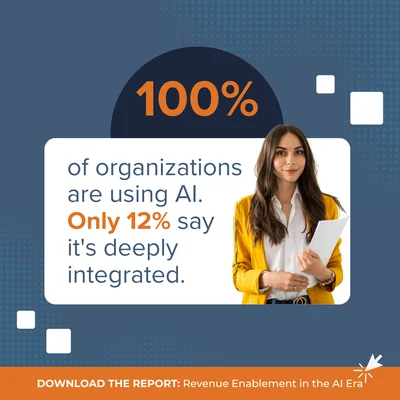
  • 100% of respondents are using or piloting AI
  • Yet only 12% describe AI as deeply integrated into daily workflows

That gap matters.

Because AI only performs as well as the systems feeding it. If your CRM contains inconsistent lifecycle stages, incomplete records, duplicate accounts, or fragmented activity tracking, AI doesn’t create clarity. It accelerates confusion.

Why CRM Hygiene Is a Revenue Problem (Not an IT Problem)

Too many organizations still treat CRM hygiene as administrative cleanup or an IT responsibility. In reality, CRM quality directly impacts how revenue teams operate, forecast, personalize, and make decisions.

When data quality declines:

  • forecasting becomes less reliable
  • personalization weakens
  • attribution gets harder to trust
  • sales prioritization becomes inconsistent

In other words, CRM hygiene is no longer a maintenance task sitting quietly in the background. It’s part of the revenue engine itself.

That distinction becomes even more important in the AI era because AI systems depend on pattern recognition. When the underlying data is inconsistent, the outputs become inconsistent too.

The Hidden Cost of Unreliable CRM Data

The consequences of poor CRM governance are rarely isolated to the CRM itself. They spread across the entire revenue organization.

AI Outputs Become Harder to Trust

AI tools rely on historical patterns and structured inputs to generate recommendations and insights. When CRM data is incomplete or inconsistent, AI struggles to identify meaningful patterns.

That can lead to:

  • Inaccurate lead prioritization
  • Weak personalization
  • Unreliable forecasting insights
  • Inconsistent recommendations across teams

The issue isn’t necessarily the AI model. The issue is the operational environment surrounding it.

Sales and Marketing Drift Further Apart

When teams stop trusting the CRM, they start building workarounds. Sales teams rely on spreadsheets. Marketing tracks data separately. Customer information lives across disconnected systems.

The report found that only 27% of respondents are very confident in the accuracy of their CRM and AI data.

That lack of trust creates downstream problems quickly. Once teams begin operating from different versions of the truth, alignment becomes harder to maintain and reporting becomes increasingly subjective.

Buyer Experiences Become Less Consistent

Many organizations talk about AI-powered personalization as if the technology alone guarantees a better customer experience.

But personalization built on unreliable data often creates the opposite outcome.

Messaging becomes mistimed. Outreach becomes irrelevant. Sales conversations fail to reflect prior buyer interactions. Instead of creating a seamless experience, automation simply delivers inconsistency at greater speed and scale.

That’s one reason the report found that confidence in personalization remains surprisingly low despite widespread AI adoption.

The “More Tools” Trap

One of the most common mistakes organizations make is assuming another AI tool will solve the problems created by disconnected systems and unreliable CRM data.

Usually, it does the opposite.

More tools layered onto poor foundations typically create:

  • More fragmentation
  • More conflicting insights
  • More dashboards
  • More operational complexity

Not more clarity.

The organizations seeing the strongest AI results are rarely the ones with the biggest tech stacks. More often, they are the ones with the cleanest operational foundations and the highest trust in their data.

What Strong CRM Governance Actually Looks Like

Organizations with high CRM trust usually have a few things in common.

They establish:

  • Clear lifecycle stage definitions
  • Consistent data-entry expectations
  • Cross-functional alignment between teams
  • Ongoing governance instead of one-time cleanup projects

Most importantly, they recognize that CRM quality is not solely a systems issue. It’s a leadership and operational discipline issue.

FAQ

Why does CRM quality matter more in the AI era?

Because AI systems depend entirely on the quality of the data feeding them. Better inputs create more trustworthy outputs.

Is CRM hygiene really a revenue issue?

Absolutely. CRM quality directly impacts forecasting, personalization, reporting, sales execution, and buyer experience.

Why do teams stop trusting CRM data?

Usually because definitions, ownership, and processes become inconsistent across teams over time.

Can AI fix poor CRM data automatically?

Not reliably. AI can help organize or enrich information, but it cannot solve underlying operational misalignment.

Want to see how revenue teams are actually approaching AI, CRM trust, and revenue enablement?

LeadG2’s Revenue Enablement in the AI Era report explores:

  • where organizations are struggling most
  • how alignment gaps affect AI performance
  • what separates incremental gains from transformational ones

The findings reveal why some AI investments compound (and why others stall).

Revenue Enablement in the AI Era CTA

5 Reasons Why PEOs Should Implement a Sales Enablement Strategy

5 Reasons Why PEOs Should Implement a Sales Enablement Strategy

According to The Center For Sales Strategy the secret to a successful sales team is summed up in the following equation. Talent + Training + Tactics...

Read More
You Don’t NEED Inbound Marketing

1 min read

You Don’t NEED Inbound Marketing

I spend a lot of time talking to people about their business needs, and if there’s one thing I know for sure, it’s that nobody needs inbound...

Read More
Why Your PEO Should Invest in Long-Term Lead Nurturing   

Why Your PEO Should Invest in Long-Term Lead Nurturing   

The prospecting your team does today often doesn’t result in closed business for several weeks or months. How do you keep a prospect engaged for an...

Read More