<img height="1" width="1" alt="" style="display:none" src="https://www.facebook.com/tr?id=808984019221058&amp;ev=PixelInitialized">

3 min read

Why Revenue Enablement Can’t Live in One Department

Why Revenue Enablement Can’t Live in One Department

Why do some organizations consistently deliver seamless buyer experiences while others struggle with disconnected messaging, inconsistent execution, and siloed teams?

Many companies still think of revenue enablement as a department responsible for sales training, content, or technology. While those responsibilities matter, they only represent a fraction of what effective enablement can accomplish.

LeadG2's Revenue Enablement in the AI Era report suggests that the organizations making the greatest progress are the ones viewing enablement as something much larger: a shared operating model that connects strategy, systems, and execution across the entire customer journey.

The short answer: the highest-performing organizations don't treat revenue enablement as a function. They treat it as a philosophy that shapes how every revenue-generating team operates.

Revenue Enablement Was Never Meant to Be a Team Sport Played by One Team

When revenue enablement is owned by a single department, it's easy for the rest of the organization to view it as "someone else's responsibility."

Sales waits for better content. Marketing waits for sales feedback. RevOps manages the technology. Customer Success builds its own processes.

Individually, each team is working hard. Collectively, they're often moving in slightly different directions.

That's where friction begins.

True revenue enablement isn't something one team delivers to another. It's the framework that helps every customer-facing function work toward the same outcomes.

Shared Ownership Creates Predictable Growth

One of the clearest themes throughout LeadG2's research is that organizations perform better when alignment extends beyond leadership meetings and organizational charts.

Revenue enablement works best when every function shares ownership of the customer journey.

That means:

Instead of optimizing individual departments, organizations begin optimizing the entire revenue system.

That's where predictability starts to emerge.

Silos Don't Just Slow Teams Down. They Change the Buyer Experience.

Most discussions about silos focus on internal inefficiency.

But buyers experience something different. They experience inconsistent messaging. They repeat information they've already shared. They receive disconnected communications from different teams. They encounter a company that feels less coordinated than it believes it is.

Those moments may seem small, but together they shape how buyers perceive your organization.

The report reflects this disconnect. While executives consistently report high confidence in areas like systems integration, centralized enablement, and content effectiveness, frontline teams paint a much different picture.

That perception gap often signals that silos still exist, even when leadership believes they've been removed.

Enablement Should Influence Every Function

If revenue enablement only affects sales training, it's too narrow.

An effective enablement philosophy influences decisions across the organization.

It shapes:

  • how marketing develops campaigns and content
  • how sales qualifies and advances opportunities
  • how RevOps designs systems and workflows
  • how Customer Success creates continuity after the sale
  • how leaders measure performance across the revenue organization

In other words, enablement becomes less about individual initiatives and more about creating consistency.

When everyone is operating from the same definitions, expectations, and customer journey, execution naturally improves.

AI Makes Organizational Alignment Even More Important

Artificial intelligence is changing how revenue teams work.

But AI doesn't eliminate the need for alignment.

It increases it.

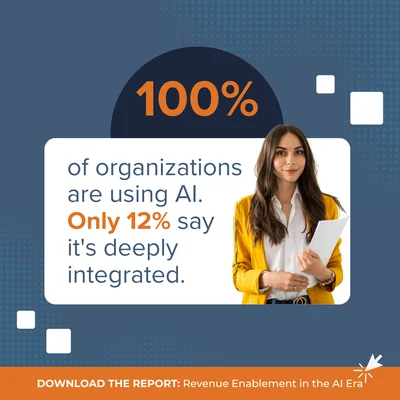
The report found that every organization surveyed is using or piloting AI, yet only a small percentage describe AI as deeply integrated into daily workflows.

Why?

Because AI depends on consistent processes, trusted data, and shared definitions.

Without those foundations, AI simply accelerates fragmented execution.

Organizations that treat enablement as an operating philosophy create the consistency AI needs to produce meaningful results.

What an Enablement Culture Looks Like

Organizations with mature revenue enablement tend to share several characteristics.

They establish:

  • shared goals across revenue teams
  • common lifecycle definitions
  • consistent messaging throughout the buyer journey
  • technology that reinforces agreed-upon processes
  • coaching that extends beyond onboarding

Perhaps most importantly, they recognize that enablement isn't something you complete.

It's something you continuously reinforce.

Like culture, it becomes part of how the organization operates every day.

FAQ

Isn't revenue enablement usually a department?

It can be, but limiting enablement to a single team often reduces its impact. The strongest organizations embed enablement principles across every revenue-generating function.

Why does shared ownership matter?

Because buyers don't experience your organization in departments. They experience one company. Shared ownership helps create a consistent journey from first interaction through long-term customer success.

How does AI change revenue enablement?

AI makes consistency more important, not less. Strong enablement provides the clean processes, trusted data, and organizational alignment AI depends on to deliver meaningful value.

What's the first step toward treating enablement as an operating philosophy?

Start by evaluating where teams operate independently instead of collaboratively. Shared definitions, goals, and customer journeys often create bigger gains than adding new technology.

The LeadG2 Perspective

One of the biggest lessons from our Revenue Enablement in the AI Era research is that revenue enablement can't live in one department if organizations expect enterprise-wide results.

The companies creating the strongest buyer experiences and the most predictable growth are the ones that treat enablement as part of their organizational DNA.

Technology supports it. Content reinforces it. Coaching develops it. Leadership models it.

When those elements work together, enablement stops being a function and becomes the way the organization operates.

Revenue Enablement in the AI Era CTA

Top 10 PEO Revenue Growth Tactics for 2026

Top 10 PEO Revenue Growth Tactics for 2026

How can PEOs actually grow revenue in 2026? That’s the real question most PEO leaders are asking right now, and the answer is not more cold calls,...
Read More
Why Most HubSpot Partners Only Solve Half the Problem

Why Most HubSpot Partners Only Solve Half the Problem

Why do some companies invest in HubSpot and still struggle with adoption, alignment, or reliable revenue insights? The Short Answer: Many HubSpot...

Read More
The HubSpot Portal Audit Playbook: 7 Hidden Efficiency Killers Slowing Your B2B Revenue

The HubSpot Portal Audit Playbook: 7 Hidden Efficiency Killers Slowing Your B2B Revenue

Your HubSpot Portal Might Be Costing You More Than You Think You invested in HubSpot because it’s powerful, intuitive, and built to fuel growth. But...

Read More