Key Takeaways from HubSpot’s INBOUND 2025: Loop Marketing Playbook, AI Agents, Data Hub, & More
What Happened at HubSpot's INBOUND 2025? HubSpot’s INBOUND 2025 Conference was one of the most transformative events in the company’s history....
AI can generate an email. It can summarize a meeting. It can produce a blog post, research an account, or help a sales rep prepare for a call.
But there's a growing difference between AI that can perform a task and AI that understands enough about your business to perform that task well.
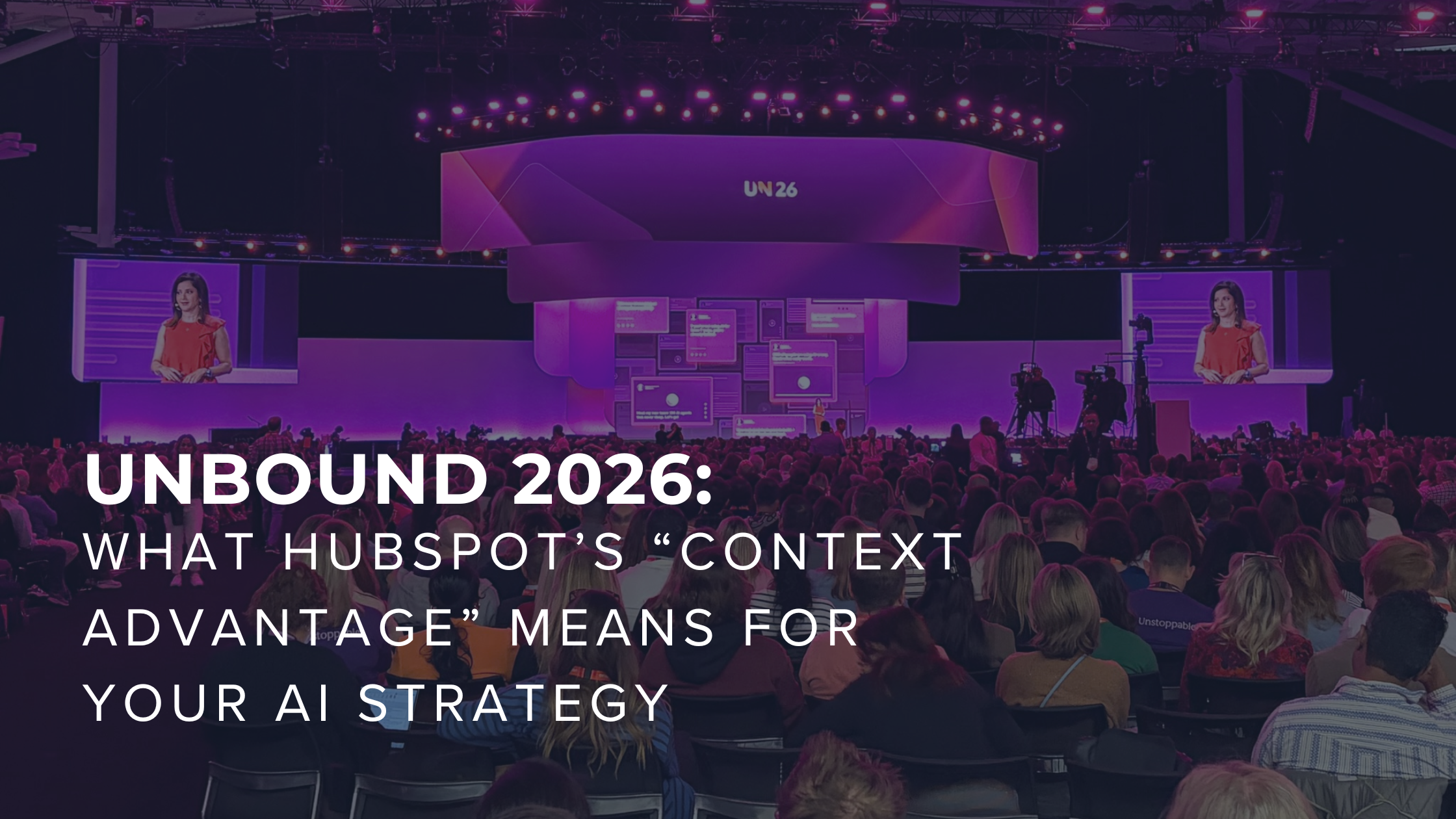
That distinction was at the heart of HubSpot's opening keynote at UNBOUND 2026: The Context Advantage.
And HubSpot's argument wasn't that businesses need more AI. It was almost the opposite.
After several years of companies experimenting with more tools, more agents, more prompts, and more use cases, HubSpot is making the case that the next phase of AI will be defined by something much more fundamental: giving AI the right business context and applying it to the outcomes that actually matter.
The Context Advantage is the idea that AI becomes significantly more valuable when it understands the business, customers, and teams it is working for.
During the UNBOUND 2026 keynote, HubSpot CEO Yamini Rangan defined context as the dynamic knowledge about your business, your customers, and your team. That can include everything from your positioning and products to customer conversations, buying signals, team goals, processes, and methodologies.
Instead of asking AI to work from a generic prompt, the goal is to give it the information necessary to understand:
That context is what can turn AI from a generic productivity tool into something much closer to an expert on your business.
And HubSpot is increasingly building that philosophy into its platform.
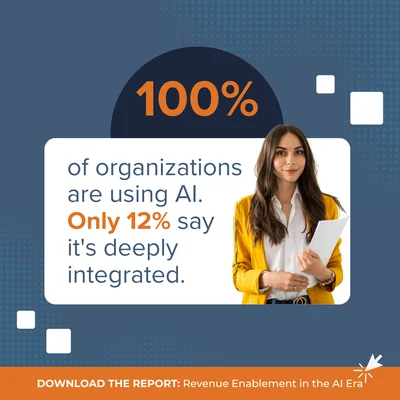
Because AI adoption is already widespread.
AI transformation isn't.
During the keynote, HubSpot shared research from 6,000 customers and prospects across multiple industries. According to HubSpot, 90% of the companies surveyed are using AI, but only 6% are seeing transformational results.
That small group stood apart in meaningful ways. HubSpot reported that these companies were four times more likely to reach their revenue targets and three times more likely to reach their efficiency targets.
So what are they doing differently?
One surprising answer: less.
HubSpot's research found that transformational companies weren't trying to deploy AI everywhere. They were concentrating on a smaller number of use cases tied directly to business outcomes.
For go-to-market teams, Rangan boiled those outcomes down to three things:
Build demand. Win deals. Delight customers.
That's a useful distinction for any business evaluating its AI strategy.
The question isn't simply, Where else could we use AI?
It's:
Where could AI meaningfully improve the outcomes we're already responsible for producing?
That shift from AI activity to business outcomes is an important part of understanding the Context Advantage.
This was perhaps the most interesting part of HubSpot's keynote.
HubSpot examined more than 50 AI use cases across the customer journey and compared how commonly they were being used with the impact businesses were seeing.
Some of the most familiar AI applications included:
They're popular because they're easy. Give an AI tool a prompt, and it can generate something almost immediately.
But HubSpot's research placed those types of activities among the lower-impact AI use cases.
The higher-impact applications looked different. HubSpot highlighted examples including:
What do those have in common?
They can't work particularly well without information that is specific to your business.
AI can't meaningfully analyze campaign performance without your campaign data.
It can't intelligently prioritize your pipeline without understanding your deals and sales data.
And it can't extract meaningful patterns from customer feedback without access to your actual customer information.
That's where context creates differentiation.
Your competitors can access many of the same AI models you can. They can ask those models to create an email, summarize an article, or generate a campaign idea.
They don't have your business context. And that's why HubSpot sees context as an advantage.
Context can easily become another vague AI buzzword, so HubSpot's keynote provided a useful framework.
Rangan broke context into three primary layers.
This is the knowledge that makes your organization uniquely yours:
Your brand. Your products and services. Your positioning. Your expertise. Your business model. Your competitive differentiators.
Without that context, an AI system may understand marketing, but it doesn't necessarily understand your marketing.
It may understand sales, but it doesn't understand how your organization sells.
This includes what your business knows about the people and organizations it serves:
Customer conversations. Ideal customer profiles. Engagement history. Intent signals. Buying behavior. Previous interactions.
This is particularly important because customer context changes constantly.
Someone who visited your website six months ago isn't necessarily the same opportunity today after consuming three pieces of content, attending a webinar, talking with a salesperson, and returning to your pricing page.
Good context reflects that history.
Finally, AI needs to understand how your people actually work.
That includes team roles, goals, processes, tools, methodologies, responsibilities, and other operational knowledge.
Combined, these layers allow AI to operate with considerably more understanding than it gets from a standalone prompt.
It's also one reason the CRM is becoming so central to the AI conversation.
Think about how much context already lives inside your CRM.
Contacts and companies. Deals. Emails. Meetings. Website activity. Customer conversations. Support interactions. Buying signals. Campaign engagement. Notes from your sales team.
That information isn't just historical documentation anymore. It can become context that AI uses to make better decisions and recommendations.
That's a meaningful shift in how businesses should think about CRM data.
For years, CRM hygiene could feel like an administrative concern. Complete the fields. Log the activity. Update the deal stage. Keep the database clean.
In an AI-powered organization, the quality of that information can directly influence the quality of what AI produces.
And HubSpot made an especially important point about that during the keynote.
More AI isn't automatically better.
And more data isn't necessarily better context.
HubSpot's research found that AI operating with bad context can produce worse outcomes than using no AI at all. Across the metrics HubSpot studied, poor context was associated with declining performance.
The reason makes intuitive sense.
Imagine AI analyzing your pipeline using the wrong definition of annual recurring revenue. Or recommending a product your company no longer sells. Or suggesting an action based on an outdated team goal.
The AI may still produce an incredibly confident answer. It's simply confidently working from the wrong information.
That's why businesses shouldn't interpret the Context Advantage as: Put everything into AI.
The better interpretation is: Build accurate, relevant, current context that AI can actually use.
That makes CRM hygiene, data governance, integrations, process consistency, and internal knowledge management part of your AI strategy rather than separate operational projects.
This is where HubSpot's UNBOUND announcements become particularly interesting.
The Context Advantage isn't being positioned as a single feature. It's a philosophy connecting many of HubSpot's latest capabilities across marketing, sales, and service.
For marketers, HubSpot is applying business and customer context to areas including AI search visibility, campaign creation, enrichment, and personalization.
HubSpot AEO, for example, is designed to help businesses understand and improve their visibility in AI search, using business data to help identify relevant prompts and opportunities.
Marketing Studio takes the idea further into campaign execution, connecting planning, creation, personalization, and measurement so AI can work with more of the information surrounding the campaign.
And Breeze Assistant can draw on HubSpot context as teams move from ideas to actual marketing execution.
The common thread isn't simply faster content creation.
It's using AI to make marketing activity more informed by the business and audience it's supposed to serve.
Sales provides an especially clear example of why context matters.
HubSpot's latest capabilities include tools designed to help teams understand buyer intent, identify prospects, prepare for interactions, progress deals, and determine next actions.
Buyer Intent can bring together signals such as website activity, research behavior, leadership changes, and funding events.
Prospecting Agent can use customer context to help identify prospects and draft outreach.
Smart Deal Progression can use deal context to surface meeting details, suggest CRM updates, and help draft follow-up.
Rather than asking a seller to piece together information across multiple systems and then decide what it means, AI can increasingly help interpret that context and make it actionable.
That's much closer to the high-impact AI use cases HubSpot highlighted during the keynote: using AI to understand and prioritize the business's actual pipeline, rather than simply generating another sales email.
The same principle applies after the sale.
HubSpot's Customer Agent can draw from documentation, CRM information, customer history, and previous interactions to resolve customer questions with greater context.
That matters because customer service is inherently contextual.
The best answer isn't always the generic answer to a question. It's the answer that makes sense for this particular customer and their history with your company.
HubSpot says its Customer Agent can now close 70% more tickets, illustrating the kind of operational outcome the company is emphasizing as it moves from AI experimentation toward measurable results.
You don't need to leave UNBOUND and implement every new AI capability at once. In fact, HubSpot's research suggests that may be exactly the wrong response.
A better starting point is to ask three questions that Rangan used to close her keynote:
Start with the business problem rather than the technology.
Do you need to generate more qualified demand? Improve conversion? Help salespeople prioritize opportunities? Increase retention? Resolve customer issues faster?
Before introducing AI into a process, determine whether the information it needs is accurate, connected, accessible, and current.
AI may lower the barrier to building workflows, agents, content, and other assets. But that makes human judgment more important, not less.
Someone still needs to decide what is worth building, whether the result is good, and whether it makes sense for the business.
That's why the Context Advantage isn't solely a technology strategy.
It's also a data, process, and people strategy.
During its UNBOUND 2026 keynote, HubSpot identified three major categories: business context, customer context, and team context. Together, they give AI a deeper understanding of the organization it's working within.
Generic AI tools can be extremely useful, but they don't inherently know your customers, CRM history, internal processes, products, positioning, or team goals.
For tasks where that information matters, providing richer context can make the output much more relevant and actionable.
Quite the opposite.
HubSpot found that companies reporting transformational AI results were pursuing fewer use cases on average. Its message at UNBOUND was to prioritize meaningful outcomes rather than maximizing the number of AI tools, agents, or experiments an organization has underway.
AI can only act intelligently on the context it's given. Inaccurate, incomplete, or outdated CRM information can produce poor recommendations and decisions, potentially at much greater scale.
Start with an outcome.
Identify one meaningful business problem, determine what information AI would need to help solve it, and then evaluate whether your CRM and connected systems provide accurate enough context to support that use case.
For the past few years, much of the AI conversation has centered on the models themselves.
Which one is smartest? Which is fastest? Which can generate the best content?
UNBOUND 2026 offered a different way of looking at the next stage.
If everyone has access to powerful AI, the model itself becomes less of a differentiator. Your business context doesn't.
Your customer relationships. Your conversations. Your history. Your processes. Your brand. Your team's expertise. Your data.
Those are things your competitors can't simply recreate with a prompt.
That's what makes the Context Advantage such an important idea behind HubSpot's latest updates. And it's why getting more value from AI may have less to do with adding another tool and more to do with creating the foundation that allows AI to understand your business in the first place.
For organizations using HubSpot, that means the health of your CRM, the way your systems connect, and how your teams use the platform are becoming increasingly important parts of your AI strategy.
LeadG2 helps organizations build that foundation and turn HubSpot into a connected revenue platform that sales, marketing, and service teams can actually use. As HubSpot's newest AI capabilities roll out, we'll continue breaking down what they mean and, more importantly, how businesses can put them to work.
What Happened at HubSpot's INBOUND 2025? HubSpot’s INBOUND 2025 Conference was one of the most transformative events in the company’s history....
Sales teams are always searching for the next big thing to help them hit their targets and generate revenue. Enter artificial intelligence (AI) –...
HubSpot’s Loop Marketing Playbook represents a major shift in how organizations approach marketing strategy. Combined with AI Engine Optimization...